more from the other side of the world...
ISPE Singapore Student Chapter Blog
looking forward to seeing more from them...
Wednesday, July 11, 2007
ISPE Singapore Student Chapter Blog

ISPE and Bio Pharm Industry in India
Check out the India Affliate of the ISPE...over 50 new members in the past couple of months...
and they just had their big industry event...
ISPE India’s Annual Conference on Aseptic Manufacturing and Contamination Controls-Current Issues and Trends
Anybody out there have any news, infromation or feedback from this event to post???
Send me a link...
Tuesday, July 10, 2007
China Admits Executing Former Food Safety Chief
[Update]
Chinese Olympic Games assures safe food supply...oh, really...
How does this play out?
The toothpaste, the fish, the pet food...these are the ones we know about...
30 years ago, China was found to be the source of questionable product which caused multiple deaths...what's changed since then?
Unfornately, executing one person doesn't show the Chinese government is serious about reforming drug and food safety...I am afraid it proves exactly the opposite...China makes an example out of one poor soul, spins the media cycle with the "we need to improve..." headline backed up with the unspoken headline; "Look how serious we are, we killed the guy..."
We all nod and agree that it is a very serious issue...
And then they go back to business as usual...
I hope we aren't having this conversation 30 years from know...and more people don't have to lose their lives in order to get some progress on this painful issue.
China's drug watchdog has admitted food and drug safety supervision in the country is poor and in need of improvement. The comments came as China executed the former head of its food and drug administration for allowing unsafe drugs to enter the market in exchange for bribes.
China's food and drug administration spokeswoman, Yan Jiangying, acknowledged to reporters Tuesday China's food and drug safety was "unsatisfactory" and the country was facing a tough situation in supervising standards.
"As a developing country, China's food and drug supervision work began late and its foundations are weak," she said. "Therefore, the food and drug safety situation is not something we can be optimistic about."
Yan's comments came as the official Xinhua news agency reported the execution of the former head of the food and drug administration, Zheng Xiaoyu, after he was found guilty of corruption and dereliction of duty.
Zheng was sentenced to death in May for accepting cash and gifts worth more than $830,000 from pharmaceutical companies. Xinhua said his appeal was rejected because of the immense damage he had caused to public health and safety.
During his time as chief, the administration approved many medicines that did not meet standards, including six fake drugs. Zheng was the highest level official to be executed in seven years.
link to full article
Monday, July 09, 2007
Pioneering treatment for brain cancer gets Swiss approval
Now we're talking...
LONDON (AFP) - An experimental treatment for brain cancer has won approval for commercial use in Switzerland, its London-listed US maker, Northwest Biotherapeutics, Inc., announced on Monday.
DCVax-Brain will be available to patients in selected hospitals and medical centres in Switzerland before the end of September, the first time a treatment of this kind has been given market authorisation, it said in a statement.
"We are delighted to be the first company to reach the market with a personalized therapeutic vaccine for brain cancers, which carry a very bleak prognosis for patients," said Alton Boynton, president and chief executive of Northwest Biotherapeutics.
DCVax-Brain is designed to treat cancer by priming the patient's immune system to attack cancer cells.
The patient's own master immune cells, known as dendritic cells, are taken from the bloodstream while they are still at an immature stage.
These precursor cells are then matured in a lab dish while being exposed to biomarkers from the patient's own tumour, thus helping them to identify the cancer foe. Once they reach adult stage, the cells are injected back into the patient's body.
DCVax-Brain is currently in the second phase of the typical three-phase process of testing a new drug for safety and efficacy before it is licenced by the US Food and Drug Administration (FDA) and other medical watchdogs. It is being tested on 141 patients in the United States with glioblastoma multiforme, an especially aggressive form of cancer.
link to full article
Nanoparticles get a free ride
A breakthrough discovery in the US could see nanoparticles hitching a ride on red blood cells to become an ultimate drug delivery mechanism.
Nanoparticles have long been seen as a promising frontier for intravascular drug delivery but advances in the technology have been limited by the problem that nanoparticles are quickly removed from the blood rendering them ineffective in delivering drugs.
But researchers at the University of California, Santa Barbara, have found a solution to the problem - attaching nanoparticles to the surface of red blood cells (RBCs) dramatically increases the in vivo lifetime of the nanoparticles.
The research is published in the July 07 issue of Experimental Biology and Medicine.
"Attachment of polymeric nanoparticles to red blood cells combines the advantages of the long circulating lifetime of the red blood cell, and their abundance, with the robustness of polymeric nanoparticles," research team leader Dr Samir Mitragotri said is a statement.
link to full article
Tuesday, July 03, 2007
Fat Kills Cancer
Check out the last line of the second paragrpagh...I assume it was very "tongue-in-cheek"...
Turning Stem Cells Taken from Fat Tissue into Personalized, Cancer-Targeted Therapeutics
PHILADELPHIA - Researchers in Slovakia have been able to derive mesenchymal stem cells from human adipose, or fat, tissue and engineer them into "suicide genes" that seek out and destroy tumors like tiny homing missiles. This gene therapy approach is a novel way to attack small tumor metastases that evade current detection techniques and treatments, the researchers conclude in the July 1 issue of Cancer Research, a journal of the American Association for Cancer Research.
"These fat-derived stem cells could be exploited for personalized cell-based therapeutics," said the study's lead investigator, Cestmir Altaner, Ph.D., D.Sc., an associate professor in the Cancer Research Institute of the Slovak Academy of Sciences in Bratislava. "Nearly everyone has some fat tissue they can spare, and this tissue could be a source of cells for cancer treatment that can be adapted into specific vehicles for drug transport."
link to full article
Thursday, June 28, 2007
Drug resistance argues against mutation theory of cancer
I love scientific discussions like this...theory and reality being compared to guide the next step in the thought process...
BERKELEY – Thirty-six years into the war on cancer, scientists have not only failed to come up with a cure, but most of the newer drugs suffer from the same problems as those available in the pre-war days: serious toxicity, limited effectiveness and eventual resistance.
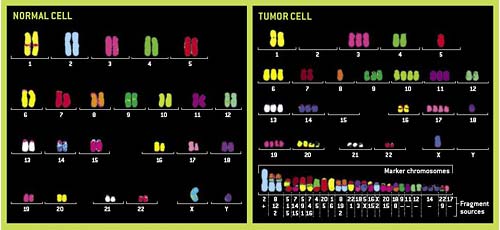
This is no surprise to University of California, Berkeley, genetics researcher Peter Duesberg, professor of molecular and cell biology. According to his novel yet controversial "chromosomal" theory of cancer, which is receiving increased attention among cancer researchers, each cancer is unique, and there is no magic bullet.
"The mutation theory of cancer says that a limited number of genes causes cancer, so cancers should all be more or less the same," Duesberg said. The chromosomal theory, which he laid out in an article in the May 2007 issue of Scientific American, implies instead that, "even if cancers are from the same tissue, and are generated with the same carcinogen, they are never the same. There is always a cytogenetic and a biochemical individuality in every cancer."
The most that can be expected from a drug, he said, is that it is less toxic to normal cells than cancer cells, and that as a result a cancer detected early can be knocked back by chemotherapy. His chromosomal theory offers hope of early detection, however, since it ascribes cancer to chromosomal disruption, called aneuploidy, that can be seen easily through a microscope.
link to full article
Wednesday, June 27, 2007
MIT locates key enzyme for reversing retardation in mice
'Elegant genetic manipulation' inhibits Fragile X symptoms
Researchers at the Picower Institute for Learning and Memory at MIT have, for the first time, reversed symptoms of mental retardation and autism in mice.
The work will be reported in the online early edition of the Proceedings of the National Academy of Sciences the week of June 25-29.
The mice were genetically manipulated to model Fragile X Syndrome (FXS), the leading inherited cause of mental retardation and the most common genetic cause of autism. The condition, tied to a mutated X chromosome gene called fragile X mental retardation 1 (FMR1) gene, causes mild learning disabilities to severe autism.
According to the Centers for Disease Control, FXS affects one in 4,000 males and one in 6,000 females of all races and ethnic groups. The prevalence of autism ranges from one in 500 to one in 166 children. There is no effective treatment for FXS and other types of autism.
link to full article
Tuesday, June 19, 2007
On the Horizon, Personalized Depression Drugs
The Human Genome should be providing more of this type of information...
Imagine that you are depressed and see a psychiatrist who explains that you have clinical depression and would benefit from an antidepressant. So far, so good. But then the doctor tells you there is a 60 percent chance that you’ll feel better with this antidepressant and that it could take as long as four to six weeks to find out, during which time you’ll probably have some side effects from the drug.
I have just described the state-of-the-art pharmacologic treatment of major depression in 2007. Don’t get me wrong; we have very effective and safe treatments for a broad array of psychiatric disorders. But in everyday clinical practice, we have little ability to predict which specific treatment will work best for you.
Laura is a case in point. A successful management consultant in her late 30s, she sought help for lifelong depression. Her treatment began with four weeks of the antidepressant Lexapro, a selective serotonin reuptake inhibitor, or S.S.R.I., without any effect. Next, I switched her to Zoloft, another S.S.R.I., since the chance of response to another member of the same drug family is about 60 percent. Again, no response. Then we moved on to Wellbutrin, an entirely different type of antidepressant, but this didn’t work either. Laura was now ready to call it quits, and who could blame her?
After nearly three months, I had still not found an effective treatment for her. Then she came in one day and said her father had recently revealed that he had been depressed and had done well on Prozac, another S.S.R.I., and she wondered if she could try it. Within three weeks, she felt markedly better, and the symptoms of her depression began to melt away.
Instead of the hit-or-miss approach I had to use with Laura, it will soon be possible for a psychiatrist to biologically personalize treatments. With a simple blood test, the doctor will be able to characterize a patient’s unique genetic profile, determining what biological type of depression the patient has and which antidepressant is likely to work best.
link to full article
Friday, June 15, 2007
Fun E Pharm
Fundamental Experiments in Pharmaceutical
check out the first episode...
the startling plot twist...
and the dramatic conclusion...
Thursday, June 14, 2007
Counterfeit Toothpaste Imported From South Africa Recalled in 4 States
How difficult will this be?
WASHINGTON (AP) -- The Colgate-Palmolive Co. said Thursday that 5-ounce tubes of counterfeit toothpaste sold in discount stores in four states under a Colgate label are being recalled because they may contain a poisonous chemical.
A Food and Drug Administration official, Doug Arbesfeld, said Wednesday that testing had found the chemical in a product with the Colgate label, but said in the initial announcement that the FDA was unsure whether it really was Colgate or a counterfeit.
"We are aware that toothpaste is something that's been counterfeited in the past," he said. "We don't want to alarm people unnecessarily."
MS USA Trading, Inc. of North Bergen, N.J., the importer involved in the initial recall announcement, said the toothpaste may contain diethylene glycol, a chemical found in antifreeze.
The company said the toothpaste, imported from South Africa, was sold in discount stores in New Jersey, New York, Pennsylvania and Maryland.
"Made in South Africa" is printed on the box and includes Regular, Gel, Triple and Herbal versions.
The trading company said the problem was discovered in routine testing by the Food and Drug Administration. It said no illnesses have been reported to date.
link to full article
Wednesday, June 13, 2007
New Drugs Declining, Research Costs Increasing, GAO Says
less innovation is normally considered a bad thing...
Drug companies are becoming less innovative, with the number of new drugs being developed failing to keep pace with the substantial increases in spending on research and development, according to congressional investigators.
A report released yesterday by the Government Accountability Office, the investigative arm of Congress, found that annual research and development spending by the pharmaceutical industry increased 147 percent, to $60 billion, between 1993 and 2004. At the same time, the number of new drug applications to the Food and Drug Administration grew by only 38 percent, and it generally has declined since 1999.
What is more, about two-thirds of the new applications were for drugs that simply represent modifications to existing medicines, while 32 percent were for potentially innovative new drugs.
"Over the past several years it has become widely recognized throughout the industry that the productivity of its research and development expenditures has been declining," investigators wrote in the 52-page report. "That is, the number of new drugs being produced has generally declined while research and development expenditures have been steadily increasing."
link to full article
Monday, June 11, 2007
Penn Researchers Find Potential New Target for Type 2 Diabetes
(PHILADELPHIA) – Researchers at the University of Pennsylvania School of Medicine have discovered a potential new target for treating type 2 diabetes, according to a new study that appeared online this week in Nature. The target is a protein, along with its molecular partner, that regulates fat metabolism.
“Over the last 10 years, we have begun to understand the importance of fat metabolism in diabetes,” notes lead author Morris J. Birnbaum, MD, PhD, the Willard and Rhoda Ware Professor of Diabetes and Metabolic Diseases at Penn and an Investigator of the Howard Hughes Medical Institute. “Type 2 diabetics are at a higher risk for cardiovascular disease because they also have disorders in fat metabolism as a result of obesity and abnormal insulin action.” Birnbaum is also the Associate Director of the Type 2 Diabetes Unit for Penn’s Institute for Diabetes, Obesity, and Metabolism.
When a person eats a meal, the pancreas usually responds by secreting insulin that signals the liver to stop making glucose and burning fat. When a type 2 diabetic eats a meal, insulin cannot stop the manufacture of glucose in the liver, but it can stop the burning of fat stores. This gives the diabetic person a “double whammy:” fatty acids accumulate from food and from the liver. Consequently, more fat is deposited in tissues and obesity worsens.
Until now there was no clear connection between insulin and the control of fat metabolism. This study shows that when insulin is present, as it is after a meal, the protein Akt2/PKB adds a phosphate group to its molecular partner PGC-1a. When this happens, PGC-1a cannot activate the genes needed for fat metabolism.
link to full article
Thursday, June 07, 2007
US scientists discover new, potentially deadly bacteria
SAN FRANCISCO (AFP) - In a dramatic case of microbial sleuthing, US scientists said they have discovered a new, potentially deadly strain of bacteria previously unknown to medicine.
The bacteria was found in a 43-year-old American woman who had traveled across Peru for three weeks and suffered from symptoms similar to typhoid fever or malaria. The woman has since recovered.
Named Bartonella rochalimae, the new species is a close relative of a microbe that sickened thousands of soldiers during the First World War with what became known as trench fever, spread through body lice.
It is also related to a bacteria identified 10 years ago during the AIDS epidemic in San Francisco as the cause of cat scratch disease, which infects 25,000 people a year in the United States.
It was this previous work on cat scratch disease related to AIDS that helped experts at the University of California San Francisco (UCSF) and the US Centers for Disease Control and Prevention isolate the new bacteria found in the female traveler.
The findings are published in the New England Journal of Medicine.
Two weeks after returning to the United States from her trip to Peru, the woman experienced potentially life-threatening anemia, a rash, an enlarged spleen, insomnia and a high fever that lasted for several weeks.
link to full article
Wednesday, June 06, 2007
Philanthropic Roche shares manufacturing technology with Africa
04/06/2007 - Switzerland-based Roche is helping African nations fight the AIDS epidemic by sharing its coveted saquinavir drug-producing technology with two more manufacturers in Ethiopia and Zimbabwe.
As part of the drug giant's Technology Transfer Initiative, the Addis Pharmaceutical factory in Ethiopia and Varichem Pharmaceuticals in Zimbabwe will be provided, free of charge, with the technical expertise and guidance to manufacture generic HIV medicine, based on processes to produce saquinavir, Roche's second line HIV medicine.
The two companies join five others across Africa which have received the technology since the initiative's launch in January last year.
A Roche spokeswoman told in-PharmaTechnologist.com the scheme was like the analogy of teaching a man to fish so he could eat for a life time, rather than handing the man a fish so he can eat for the day.
By being locally manufactured, the dependency on western countries for treatment would be greatly reduced, she said.
Roche chief executive William Burns said in a statement: "These new agreements highlight the positive contribution that the Technology Transfer Initiative is making to help strengthen and expand local manufacturing capabilities for HIV medicines in Africa. Now entering its second year, the initiative reinforces Roche's commitment to find long-term, sustainable solutions to help increase access to healthcare in the world's poorest countries."
A team of Roche experts will work onsite at the manufacturing facilities in Ethiopia and Zimbabwe to help transfer the technology.
link to full article
Tuesday, June 05, 2007
Pa. hospitals, research groups split up $45M in tobacco funds
Everybody stop smoking!!!
Twenty-three area hospitals, research institutions and other health-care organizations were among the 38 Pennsylvania entities awarded a total of $45 million in health research grants from a portion of the state's tobacco industry settlement.
The money is being awarded under the Commonwealth Universal Research Enhancement program, which Gov. Ed Rendell said is designed to advance the work being conducted at Pennsylvania's leading medical and health research institutions. "This research will ultimately have a positive impact on the health of our residents," Rendell said.
The largest grant recipient was the University of Pennsylvania, which will receive $8.47 million for 10 projects that range from creating a health-services research data center to establishing a tumor tissue bank for cancer research.
Other large grants recipients include Thomas Jefferson University, which will receive $3.7 million for five projects including three aimed at developing new gene-based treatments for cancer; and $3.3 million awarded to the Children's Hospital of Philadelphia to discover and determine the underlying genetic causes of, and contributors to, a variety of childhood diseases.
link to full article
Monday, June 04, 2007
Scientist Gets Own Personal Genome Map
I want one!!!...
The Nobel Prize-winning scientist who helped discover the molecular structure of DNA has become the first person to receive his own personal genome map.
The map, a breakdown of his DNA that shows illnesses he is predisposed to contracting, is the first step in making the sequencing of individual human genomes quick, affordable and a routine part of medical care, according to researchers.
"I knew I was risking possible anxiety when I saw it," said 79-year-old James Watson, who was presented the map during a ceremony at Baylor College of Medicine. "But it's much more that if I don't sleep at night it's due to thinking about Iraq rather than about my genome."
Watson was chosen for the project because of his contributions to the field, and the map was completed after he submitted a blood sample.
link to full article
Friday, June 01, 2007
Cellular message movement captured on video
This stuff continues to amaze me...it could be, of course, that I am easily impressed...
Proper signaling step required for controlled cell growth -- otherwise, cancer and other diseases can result
Scientists have captured on video the intracellular version of a postal delivery service. Reporting in the journal Biochemical and Biophysical Research Communications (BBRC), bioengineering researchers at UC San Diego published videos of a key message-carrying protein called paxillin moving abruptly from hubs of communication and transportation activity on the cell surface toward the nucleus. Paxillin was labeled with a red fluorescence marker to make it stand out in live cells.
“It’s amazing to us. We thought the cell was so simple,” said Shu Chien, the senior author of the BBRC paper and a professor of bioengineering at UCSD’s Jacobs School of Engineering. “But it’s really very complex and I’m not sure we’re covering much as yet. We certainly don’t know all the interactions among these molecules that bring the cell into action.”
Examining living cells through a microscope, Chien and the paper’s co-author, associate project scientist Ying-Li Hu, filmed red-fluorescence-tagged paxillin molecules traveling from cells’ outer membrane along green-fluorescence-labeled traces of cytoskeleton. Even without video evidence, scientists have confirmed over the past 10 years that higher organisms use paxillin as a transmitter of locomotion and gene-expression signals from several classes of growth-factor receptors to the nucleus.
link to full article
link to University of California - San Diego
Thursday, May 31, 2007
Massachusetts' biotech plan may top peers'
Specialists: Outline hints it may be more flexible, cost-effective
By Stephen Heuser, Globe Staff | May 31, 2007
Governor Deval Patrick's proposal to inject $1 billion into medical research and biotechnology is a complex plan whose details have yet to be worked out, and it depends on the Legislature's willingness to fund it over a decade. But his strategy could also be more flexible and cost effective than competing plans in California and other states, according to policy specialists and a Globe analysis.
Patrick unveiled his Life Science Initiative this month before a packed crowd in Boston at the world's largest biotech convention, saying it would combat "competitor states and foreign nations" trolling aggressively for a piece of the state's marquee industry. He promised money for a new stem-cell bank, job training, and biomedical research, as well as tax breaks for companies hiring new workers.
Behind the $1 billion promise is a stream of money that is far from guaranteed. The Senate and House would need to find $25 million in the state budget every year for 10 years. They would also need to authorize $500 million in new bonds and write a new law making life-science companies eligible for up to $250 million in tax benefits.
"This is an initiative that's probably just starting -- that's going to require a lot of moving parts to come together to make it go," said Patrick Kelly , a vice president at the national Biotechnology Industry Organization who tracks state biotechnology policies.
link to full article
Tuesday, May 29, 2007
China sentences former drug official to death
Holy Crap!!!...
29/05/2007 - China has today sentenced to death the former director of its State Food and Drug Administration (SFDA), on charges of corruption, according to reports in the Chinese media.
The hardline approach may be an attempt by the country to demonstrate to the world its seriousness in stamping out the corruption that is reportedly rife throughout the healthcare and pharmaceutical, among other industries, and has been muddying the country's reputation, causing it to miss out on billions of dollars of foreign investment.
The death penalty was slammed on Zheng Xiaoyu by a Beijing court for taking over $850,000 (€632,000) worth of bribes in the form of cash and gifts. Incidently he also received a sentence of seven years' imprisonment for dereliction of duty.
In addition, all Zheng's personal property was confiscated and he was deprived of his political rights for life, according to media reports. His wife and son are also implicated and are still being investigated, among others who are believed to be involved.
Zheng, who reigned as China's chief drug and food official between 1997 and 2006, does, however, still have the right to appeal.
link to full article
Subscribe to:
Posts (Atom)

